The following are books that I authored or edited that have come out or are in press. I have other books in the works on 1990s Japanese cinema, Japanese film theory and other topics, so stay tuned for those.
- Visions of Japanese Modernity: Articulations of Cinema, Nation, and Spectatorship, 1895-1925
- 日本戦前映画論集—映画理論の再発見
- Decentering Theory: Reconsidering the History of Japanese Film Theory
- Research Guide to Japanese Film Studies
- 日本映画研究へのガイドブック
- A Page of Madness: Cinema and Modernity in 1920s Japan
- Kitano Takeshi
- In Praise of Film Studies: Essays in Honor of Makino Mamoru
Visions of Japanese Modernity
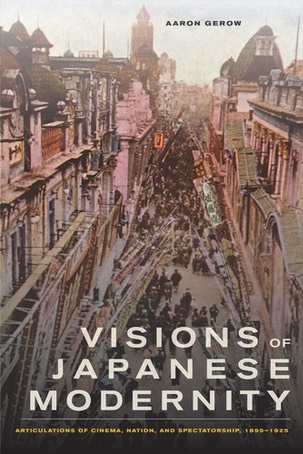
Visions of Japanese Modernity: Articulations of Cinema, Nation, and Spectatorship, 1895-1925 (University of California Press, 2010).
After a long wait, my "magnum opus" is finally out. Here's the main blurb:
"Japan has done marvelous things with cinema, giving the world the likes of Kurosawa, Mizoguchi, and Ozu. But cinema did not arrive in Japan fully formed at the end of the nineteenth century, nor was it simply adopted into an ages-old culture. Aaron Gerow explores the processes by which film was defined, transformed, and adapted during its first three decades in Japan. He focuses in particular on how one trend in criticism, the Pure Film Movement, changed not only the way films were made, but also how they were conceived. Looking closely at the work of critics, theorists, intellectuals, benshi artists, educators, police, and censors, Gerow finds that this trend established a way of thinking about cinema that would reign in Japan for much of the twentieth century."
I was very fortunate that some people whom I really respect wrote some kind recommendations for the book:
日本戦前映画論集―映画理論の再発見 Rediscovering Classical Japanese Film Theory-An Anthology
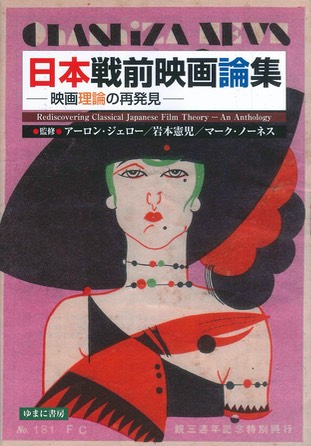
『日本戦前映画論集—映画理論の再発見』 (ゆまに書房, 2018年)
Edited by Aaron Gerow, Iwamoto Kenji, and Markus Nornes
ISBN 978-4-8433-5365-3 (paper)
Nihon senzen eigaronshu: Eiga riron no saihakken is a groundbreaking publication, collecting many of the most exciting writings about the nature of cinema written before 1945 in Japan. If Euro-American film scholars have largely ignored film theory produced by the non-West—Noel Burch, for instance, once asserted that “the very notion of theory is alien to Japan”—and if Japanese scholars have mostly ignored their own tradition of film theory, this anthology proves that a rich and vibrant history of deep thinking about motion pictures existed from the 1910s on.
The volume is 746 pages in length with over 65 selections from over 50 authors. It covers writings on cinema before 1945, and is divided into 13 chapters, covering a variety of topics such as early cinema, sound, montage, machine art, Marxism, criticism, audiences, animation, Japanese film, psychology, time and the frame, and nation. Each chapter has its own commentary, and features four to six pieces, each piece accompanied by a specially written commentary. Markus Nornes, Iwamoto Kenji, and I split up much of these duties, but we also asked scholars such as Saito Ayako, Koga Futoshi, Watanabe Daisuke, Yamamoto Naoki, and Tsunoda Takuya to help as well. I wrote the introduction, which touches on problems of the “theory complex," and Iwamoto-sensei and Markus each wrote short afterwords.
Decentering Theory: Reconsidering the History of Japanese Film Theory
Decentering Theory: Reconsidering the History of Japanese Film Theory. Issue 22 of the Review of Japanese Culture and Society (December 2010)
This is a special issue of the Review of Japanese Culture and Society that I guest edited. It is the first publication in a non-Japanese language dedicated to considering the rich and varied history of Japanese film theory. It presents both translations of some of the major works and scholarly analyses of those theorists and their historical contributions to film thought. A major theme throughout the issue is the unique problem of how to approach and define film theory in Japan.
Thinkers represented include Nakai Masakazu, Hasumi Shigehiko, Yoshida Kiju (Yoshishige), Imamura Taihei, Gonda Yasunosuke, Sato Tadao, Kitada Akihiro, and Nakamura Hideyuki, with works ranging in era from 1914 to 2011. They all focus on questions of the status of cinema and how to approach it, but other topics broached include animation, early cinema, mediation, spectatorship, documentary, meaning, and Ozu Yasujiro. A translation of one of Akutagawa Ryunosuke's "film scripts" is also included.
Research Guide to Japanese Film Studies
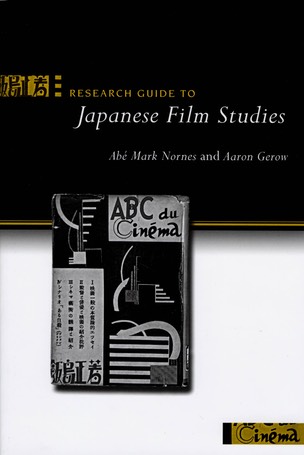
Research Guide to Japanese Film Studies (Center for Japanese Studies, The University of Michigan, 2009)
Co-authored with Abé Mark Nornes
ISBN 978192928053X (cloth)
ISBN 9781929280544 (paper)
"In its field I cannot imagine a research guide more needed. For whole decades scholars have struggled simply to locate sources, even to find out what there were. Now, however, the skill and stamina of Nornes and Gerow have resulted in a reference work which both illuminates and defines this field, clearing a formerly obscured terrain for future scholarship." —Donald Richie
"Every national cinema should be graced with such a resource as the one Nornes and Gerow have so generously and painstakingly assembled. This is a welcome and welcoming gateway through which will pass the next generation of scholars, able at last to swiftly draw on all that is available, as they make more become available in turn. Let’s hope that generation will exhibit the drive, clarity, comprehensiveness, and vision that these authors display. Their ‘frequently asked questions’ are ones I have been asked for decades; at last I have the answers." —Dudley Andrew, Yale University
日本映画研究へのガイドブック
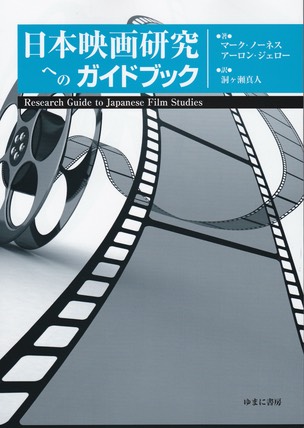
『日本映画研究へのガイドブック』 (ゆまに書房, 2016年)
Co-authored with Abé Mark Nornes
ISBN 978-4-8433-4939-7 (paper)
The Japanese version of the Research Guide to Japanese Film Studies that Markus Nornes and I produced back in 2009 has just been published by Yumani Shobo. This is not just a translation of our guide to archives, reference books, and websites important to the study of Japanese film, but a major update of the Guide. Not only have a few errors been corrected or addresses or URLs updated, but we’ve added or revised quite a number of entries, taking into account new archives and books as well as changing circumstances since 2009. Those of you who have used the English version and can read Japanese should get this version in order to obtain the most up-to-date information.
We were fortunate that Dogase Masato supervised the translation, working with Otake Mizuho, Murakami Satoru, and Sawa Shigehito. They did a splendid job. The staff at Yumani also worked hard, checking all the phone numbers and addresses, and even allowing additions up until the last moment. It was a pleasure working with everyone.
A Page of Madness
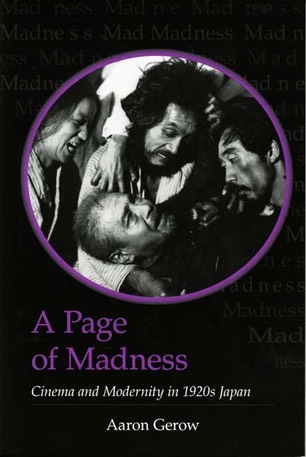
A Page of Madness: Cinema and Modernity in 1920s Japan (Center for Japanese Studies, The University of Michigan, 2008)
ISBN 9781929280513 (cloth), ISBN 9781929280520 (paper)
It's finally out! And here's the blurb:
"Kinugasa Teinosuke’s 1926 film, A Page of Madness (Kurutta ichipeiji), is celebrated as one of the masterpieces of silent cinema. It was an independently produced, experimental, avant-garde work from Japan whose brilliant use of cinematic technique was equal to if not superior to that of contemporary European cinema. Those studying Japan, focusing on the central involvement of such writers as Yokomitsu Riichi and the Nobel Prize winner Kawabata Yasunari, have seen it as a pillar of the close relationship in the Taisho era between film and artistic modernism, as well as a marker of the uniqueness of prewar Japanese film culture.
"But is this film really what it seems to be? Using meticulous research on the film’s production, distribution, exhibition, and reception, as well as close analysis of the film’s shooting script (which is not the script currently attributed to Kawabata) and shooting notes recently made available, Aaron Gerow draws a new picture of this complex work, one revealing a film divided between experiment and convention, modernism and melodrama, the image and the word, cinema and literature, conflicts that play out in the story and structure of the film and its context. These different versions of A Page of Madness were developed at the time in varying interpretations of a film fundamentally about differing perceptions and conflicting worlds, and ironically realized in the fact that the film that exists today is not the one originally released. Including a detailed analysis of the film and translations of contemporary reviews and shooting notes for scenes missing from the current print, Gerow’s book offers provocative insight into the fascinating film was - and still is - and into the struggles over this work that tried to articulate the place of cinema in Japanese society and modernity.”
Kitano Takeshi
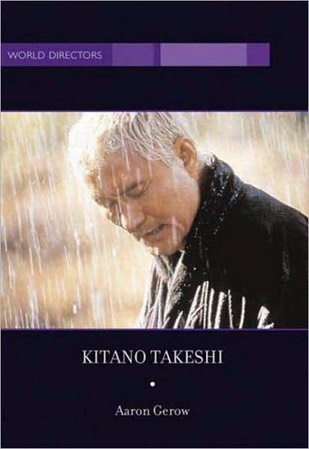
Kitano Takeshi (BFI, 2007)
ISBN 9781844571659 (cloth)
ISBN 9781844571666 (paper)
From the blurb:
“The award-winning art film Hana-Bi,Sonatine the stoic gangster elegy , the surfer romance A Scene at the SeaGetting Any?, the absurdist comedy , the entertainment samurai spectacle ZatoichiViolent Cop—very different films made under one name, Kitano Takeshi. Who is Kitano Takeshi?—an artistic auteur in the traditional sense or a new kind of star who manages multiple identities, strategically changing them from film to film and situation to situation? This book explores issues of auteurship and stardom in the films of Kitano Takeshi, especially as they relate to problems of personal and national identity in a Japan confronting an age of globalization. Aaron Gerow combines a detailed account of Japanese film and criticism with unique close analyses of Kitano's films from to Takeshis'.”
Donald Richie has written a very kind review in the Japan Times.
Tom Mes, author of Agitator

In Praise of Film Studies
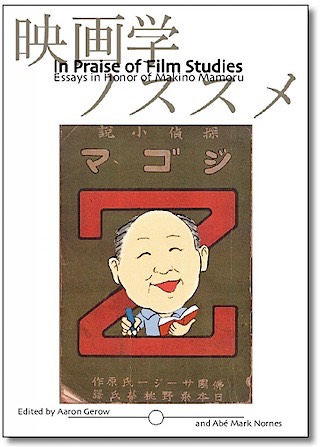
In Praise of Film Studies: Essays in Honor of Makino Mamoru. Edited by Aaron Gerow and Abé Mark Nornes. (Kinema Club, 2001)
ISBN 9781552126400
A unique and somewhat peculiar book collecting essays written in either English or Japanese in honor of Makino Mamoru, a Japanese film scholar and collector whose research and mentorship has helped so many of us movie researchers. It also contains translations of some of his representative articles on such topics as film censorship and left-wing film movements and a bibliography of his work.
More information, including the full text of the introduction, is available on the Trafford Publishing website.
You can also access the full text of the entire book on Google Books.